Wissenschaftsbotschafterin — How one might imagine time travel
Updated: Mar 13

Imagining Time Travel: A Science Ambassador Visit to a Vienna Kindergarten
On March 9, I had the opportunity to visit KIWI-Kindergarten Steinergasse I in Vienna as part of the OeAD Young Science – Science Ambassadors (Wissenschaftsbotschafter:innen) initiative. The program connects researchers with schools and educational institutions across Austria, allowing scientists to share their research and curiosity directly with young learners.
For this visit, the theme was both playful and ambitious: How can we imagine time travel?
Understanding time through everyday experience
Explaining complex scientific ideas to very young children requires starting with experiences they already know. Instead of talking about physics immediately, we began with something familiar: waiting.
We talked about situations where time can feel very long—like sitting in a car for a long ride. The children immediately recognized that feeling: the moment when the journey seems to take forever before finally arriving somewhere new.
From there, we transformed the idea into a visual exercise.
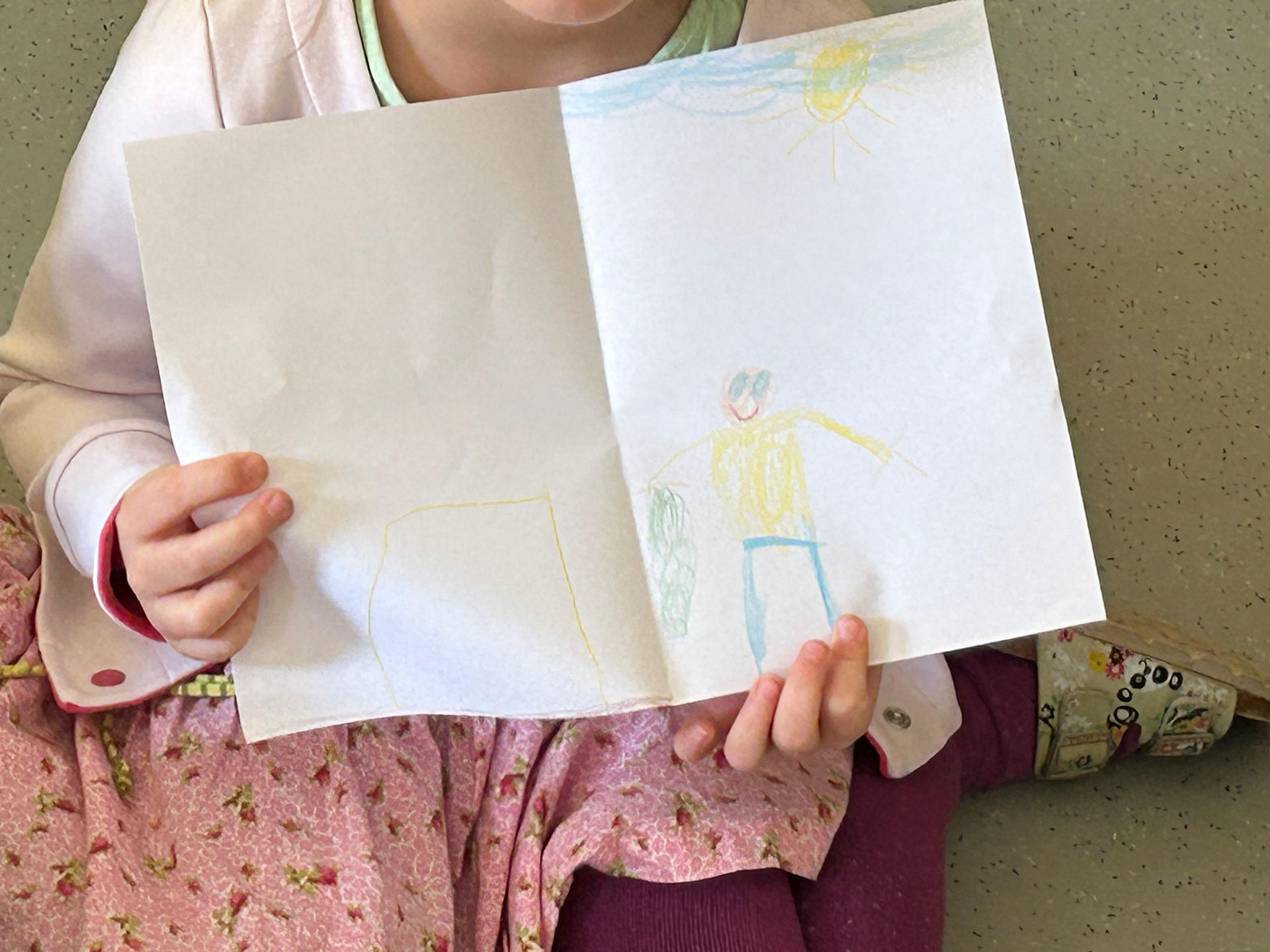
The children drew their home on the left side of a page and the place where they arrived on the right side. When they quickly opened and closed the page, the paper made a playful clapping sound, symbolizing the sudden jump from one moment to another.
In this simple gesture, the long waiting time suddenly collapsed into a single movement—almost like teleportation.
The exercise became a playful way to imagine what it might mean to move through time extremely fast, inspired by the idea of technological futures where movement could happen at incredible speeds—perhaps even at scales scientists describe in attoseconds.
Painting time travel
After this introduction, the children expanded their ideas through painting. Their artworks imagined what time travel might look like: colorful machines, portals between worlds, dinosaurs from the past, and futuristic cities.
The paintings became a way for the children to explore time not only through discussion, but through visual storytelling and imagination.
Art proved to be a powerful bridge between scientific curiosity and creative expression.
Science outreach through collaboration
The visit was part of the Science Ambassadors program coordinated by OeAD, which brings researchers into schools and educational environments across Austria.
This activity was connected to collaborations involving the TU Wien Institute of Photonics, in collaboration with researcher Alessandra Bellissimo, the Universität für angewandte Kunst Wien, and its Zentrum Didaktik für Kunst und interdisziplinären Unterricht (Center for Didactics of Art and Interdisciplinary Education). The exchange between art education and scientific research helped shape a workshop format that combines imagination, storytelling, and scientific thinking.
Strengthening trust in science
Programs like the Science Ambassadors initiative do more than introduce scientific topics—they also play an important role in society. The initiative is supported by the Bundesministerium für Bildung and the Bundesministerium für Frauen, Wissenschaft und Forschung as part of broader efforts to strengthen science communication.
Encounters between researchers and young learners are considered an important democratic measure: they help build trust in scientific knowledge, encourage critical thinking, and counteract the spread of misinformation and science skepticism.
Curiosity as the starting point
The workshop showed how naturally children approach complex ideas when they are invited to imagine freely. By connecting everyday experiences like waiting with playful activities like drawing and painting, abstract ideas about time suddenly became tangible.
The children’s artworks—ranging from prehistoric adventures to futuristic machines—demonstrated that curiosity about time, technology, and the future begins very early.
Sometimes, understanding time travel does not start with equations.Sometimes it begins with a drawing, a clap of paper, and a big question.




Comments