Culture Screen: From Osaka to Bad Ischl – A World on a Folding Screen
Updated: 3 hours ago

Culture Screen goes Bad Ischl
Venue: Hotel Austria – Museum of the City of Bad Ischl
Address: Esplanade 10, 4820 Bad Ischl, Austria
Opening hours: Monday, Wednesday–Sunday, 10 am–5 pm
Venue: Galerie AM FLUSS Address: Hasnerallee 2, Bad Ischl Window presentation: from 9 October to 15 November 2026
Wabisabi Vintage Kimono Fashion Pop-Up: 16 – 18 October 2026
--> and a selected Wabisabi collection will be available for purchase in the museum store at Hotel Austria - Museum of the City of Bad Ischl.

Culture Screen: From Osaka to Bad Ischl – A World on a Folding Screen
9 October – 15 November 2026 | Hotel Austria – Museum of the City of Bad Ischl, Austria
How do we represent society, its hierarchies, and the roles we inhabit?
And what can a historical Japanese folding screen tell us about the world we live in today?
These questions lie at the heart of Culture Screen, an artistic and educational project to bring together perspectives from Japan and Austria through art, cultural heritage, and interdisciplinary exchange.
Inspired by the 17th-century Osaka folding screen preserved at Schloss Eggenberg in Graz, the project takes a historical representation of society as its point of departure. The screen depicts people across different social positions, inviting us to consider how identities, hierarchies, and relationships are constructed and represented.
For me, it offers more than a historical image: it is a starting point for questioning how we understand society today and how artistic practice can open up new interpretations.
From Tokyo to Osaka: An Ongoing Dialogue
In 2025, Culture Screen developed into an international collaboration between the University of Applied Arts Vienna and Tokyo University of the Arts. Presentations in Japan offered opportunities to bring together students, artists, and different cultural perspectives around a shared historical reference.
At the Geidai Festival in Tokyo, from 5–7 September 2025, the project created a space for artistic responses and intercultural exchange. The presentation at EXPO 2025 Osaka, in the Austrian Pavilion, extended this dialogue to an international audience. Through augmented reality and the Artivive App, the project also explored how digital technologies can connect historical objects with contemporary artistic interpretations.
These encounters strengthened my conviction that art and art education can create meaningful spaces for exchange across cultural and geographical boundaries. Rather than seeking a single interpretation of the historical screen, we are interested in the diversity of perspectives that emerge when people engage with it from different positions and experiences.
Read more about the Culture Screen presentation at the Geidai Festival in Tokyo.
Explore the Culture Screen project at EXPO 2025 Osaka.
A New Chapter in Bad Ischl
With the exhibition Emperor, King, Nobleman, Citizen, Farmer, Beggar. Culture Screen – A World Stage in a Folding Screen, the project continues in Bad Ischl bringing together artists from Japan and the Salzkammergut, art students from Japan and Austria, and school students from Vienna.
For this presentation, we wanted to extend the dialogue beyond the original historical reference and create a setting in which different generations, artistic approaches, and lived experiences could meet. The exhibition becomes a world stage:
a place where social roles, cultural narratives, and individual perspectives can be questioned, juxtaposed, and reimagined.
I see this process of bringing people together as central to my work at the intersection of art, research, and education. Collaboration is not simply a way of producing an exhibition; it is a method of learning from differences, challenging familiar assumptions, and discovering new ways of seeing.
The project also reflects the ongoing interest in how artistic practice can connect research with public engagement. By working across disciplines and cultural contexts, Culture Screen invites us to consider how we represent ourselves and others, whose perspectives become visible, and how the structures of society might be understood differently.
Exhibition in Bad Ischl

The exhibition is presented at Hotel Austria – Museum of the City of Bad Ischl, from 9 October to 15 November 2026.
Venue: Hotel Austria – Museum of the City of Bad Ischl
Ground floor level & Hallway in the 1st and 2nd level at the arcades
Address: Esplanade 10, 4820 Bad Ischl, Austria
Opening hours: Monday, Wednesday–Sunday, 10 am–5 pm
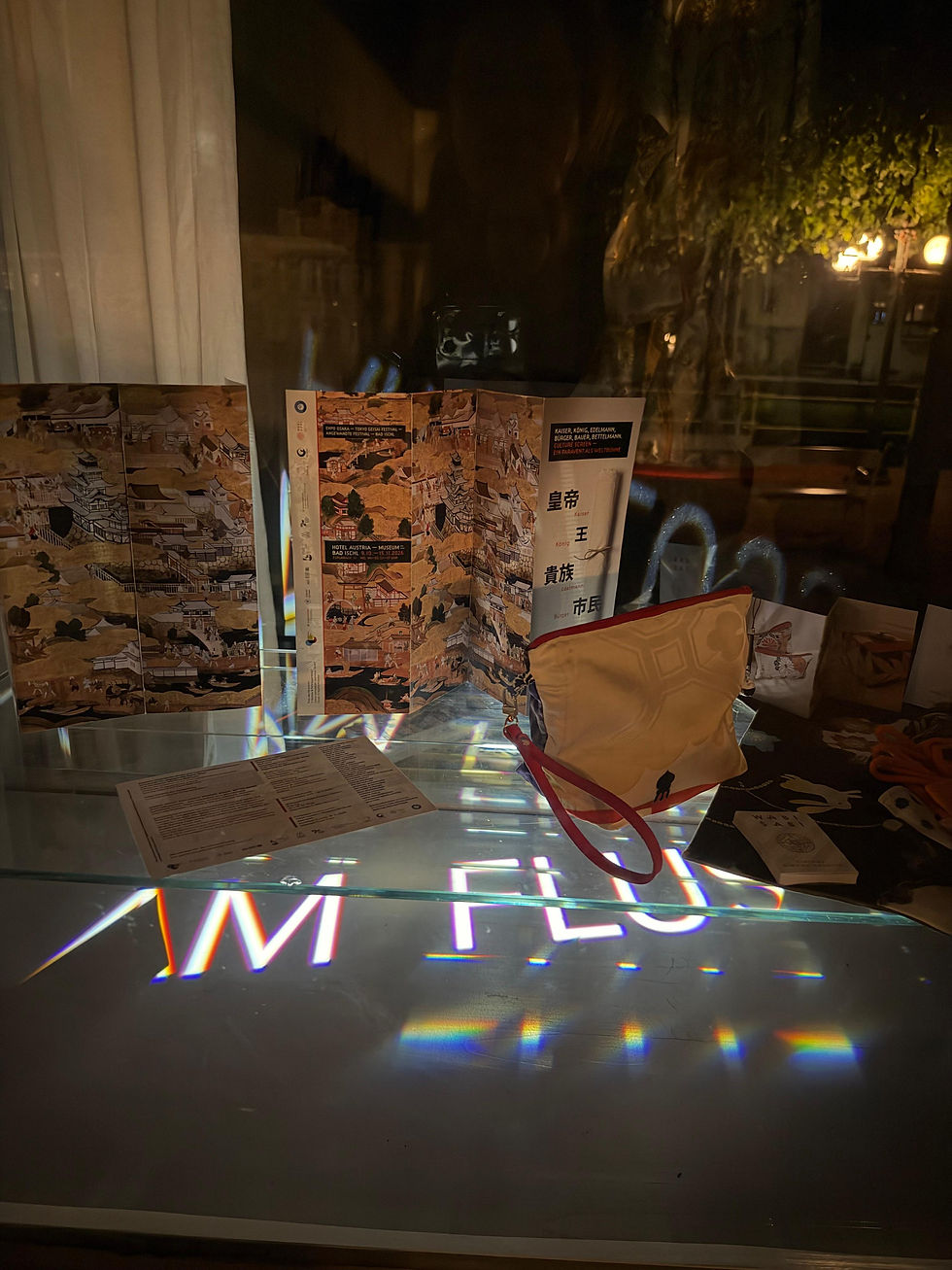
Additional Venue
The exhibition is accompanied by a shop-window presentation at Galerie AM FLUSS, Hasnerallee 2, Bad Ischl, running from 9 October to 15 November 2026. A Wabisabi Vintage Kimono Fashion Pop-Up will take place at the gallery from 16–18 October 2026, further extending the dialogue between Japanese and Austrian cultural traditions.
Finissage
Sunday, 15 November 2026, at 11 am
Matinee at Hotel Austria – Museum of the City of Bad Ischl
My Artistic Contribution: Archives of the Living — MA – MATSU – MATSU
間 — 松 — 待つ | In-Between Space. Pine. Waiting.
Within Culture Screen, I am also participating as an artist with my work Archives of the Living — MA – MATSU – MATSU, an exploration of the relationships between nature, memory, time, and the possibilities of change.
In my artistic practice, painting becomes a form of knowledge.
My series Archives of the Living investigates plants as carriers of ecological, cultural, and historical memory, bringing together scientific research, mythology, and artistic intuition in a multilayered engagement with the living world.
With MA – MATSU – MATSU, I turn my attention to the pine tree and three Japanese terms: Ma (間), meaning the space in between; Matsu (松), the pine; and Matsu (待つ), to wait. Their linguistic proximity becomes the starting point for an investigation into time, memory, and transformation.
In Japan, the pine is a symbol of longevity and renewal. In my paintings, it emerges through layers, overlapping forms, and interruptions.
The work reflects a process in which knowledge is not understood as a final conclusion, but as an ongoing approach to understanding the world.
The Japanese folding screen, or byōbu (屏風), extends this investigation into space. Its folds open up shifting perspectives, making the relationship between what is visible and what remains concealed physically perceptible. The screen becomes more than a surface for images: it creates an in-between space in which different viewpoints can coexist.
A living pine tree in the museum garden extends the work into a participatory installation. Visitors are invited to write down what they do not wish to carry into the future and hang their notes on the tree. This gesture draws on the Japanese practice of leaving unfavourable omikuji fortunes at a shrine rather than taking them away.
Through this collective act, an archive of letting go begins to emerge. Personal memories meet broader questions concerning war, violence, ecological destruction, and the possibility of imagining a different future.
With this work, I turn the traditional function of the archive on its head. Rather than preserving only what we consider worthy of remembrance, the archive temporarily holds what we wish to overcome. It becomes a space for acknowledging the past while creating room for transformation.
Between the painted and the living pine, between inside and outside, preservation and release, a space opens up that recalls the Japanese aesthetic concept of Ma. The pine becomes a silent witness to a future whose shape remains unknown.
At the centre of this work is not simply the act of waiting for change, but a more fundamental question:
What are we willing to leave behind to make change possible?
Participating Artists
Yulia Becker, Simona Bergmann, Sonja Dieplinger, Lena Fürjesi, Sofia Gross, Nick Gröller, Elisabeth Hansa, Daniel Hayden, Linda Hnatovic, Paul Iby, Mizuki Jones, Makiko Kawakami, Rintaro Kato, Sophie Koschitz, Tomohiro Kubota-Oguiss, Marlene Lerperger, Robert Lösch, Ruth Mateus-Berr, Susanne Meerwald-Stadler, Diana Morzy, Tanja Prušnik, Pia Scharler, Michael Schneider, Michaela Schober, Sayoko Suwabe, Max Steinacker, Teresa Trimmel, Derya Ünlü, Nina Wandruszka, Johanna Winklhofer, and Shu Yan.
The exhibition also features school students from Schulschiff Bertha von Suttner, Vienna.
Collaboration and Thanks
I would like to thank my co-curators Anita Kern and Daniela Auerbach (Galerie AM FLUSS) for their collaboration, commitment to the project and hard work, as well as all participating artists, students, and educational partners who have contributed their perspectives and creativity.
My sincere thanks also go to all supporting institutions, sponsors, and collaborators:
Die Angewandte – University of Applied Arts Vienna;
Galerie AM FLUSS;
the Center for Didactics of Art and Interdisciplinary Education;
Tokyo Geidai University + Michael Schneider;
Museums of Bad Ischl;
the City of Bad Ischl;
BMEIA;
Artivive;
niippon-ya;
Sake Nova;
Restaurant Izakaya & Japan-Shop Shirakura;
Pfandl Gärtnerei;
LSB Gartenbau;
Hagebau Eisl;
mdw – University of Music and Performing Arts Vienna;
WKO Austria;
Wabisabi – Vintage Kimono;
and GRG Schulschiff Bertha von Suttner
...any many many more!!
--
For me, Culture Screen is an ongoing process rather than a singular exhibition. Its journey from Japan to Austria demonstrates how a historical object can become a shared space for contemporary artistic inquiry, intercultural exchange, and reflection on the society we create together. I look forward to seeing how these conversations continue to evolve through the contributions of the artists, students, and audiences who encounter the project.
Comments